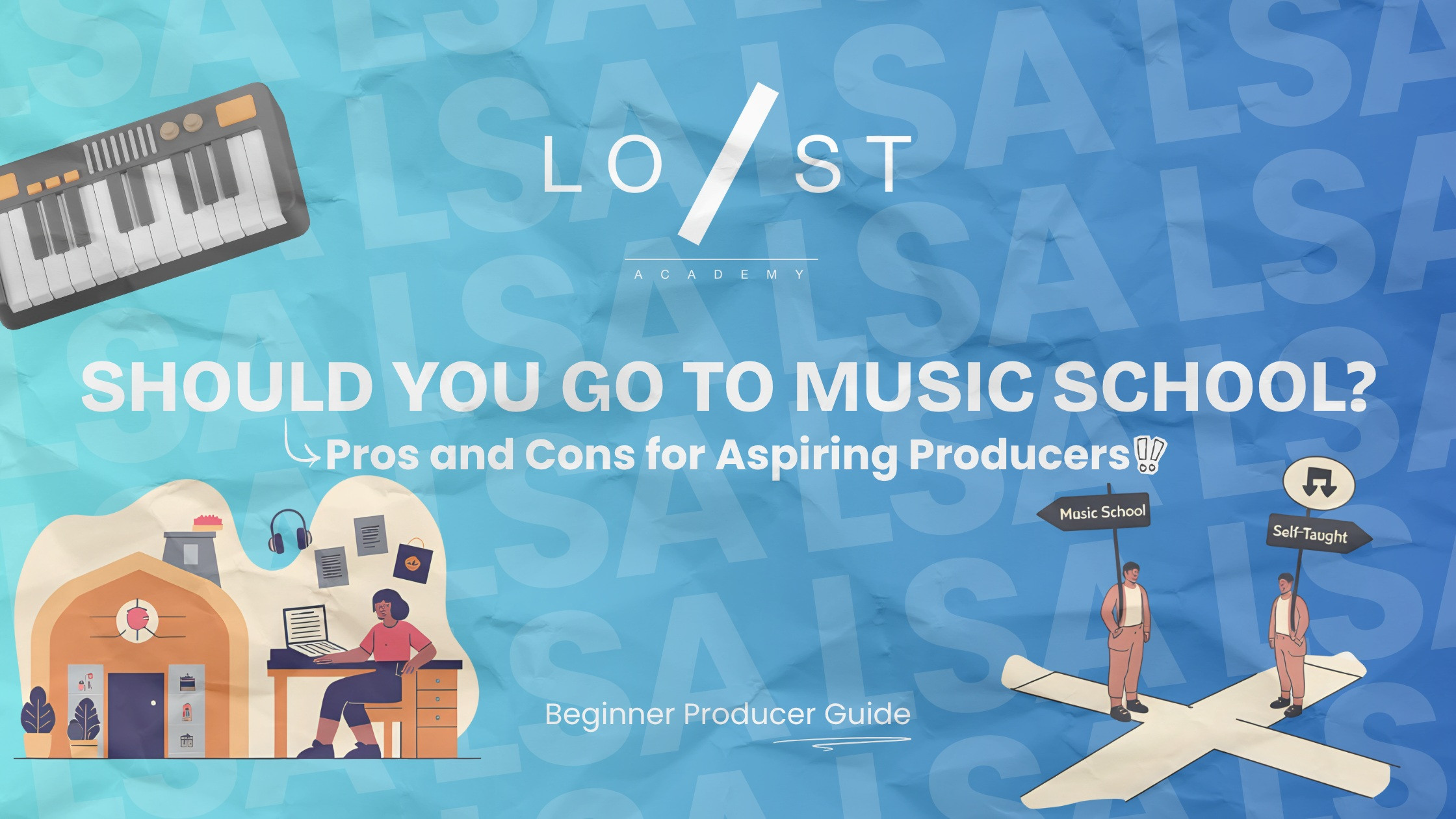
If you’ve ever spent hours scrolling through music tutorials, watching your favorite artists break down their songs, and wondered “Should I go to music school?” you’re not alone. It’s one of the most common questions aspiring producers ask themselves.
The idea sounds appealing, state-of-the-art studios, knowledgeable mentors, and a community of like-minded creatives. But at the same time, the internet is full of self-taught producers who’ve built successful careers without a formal degree.
So, which path is right for you? Let’s break it down, not with theory, but with real perspective and experience.
When you start learning music production on your own, it’s easy to get lost in the chaos, one day you’re learning compression, the next day you’re stuck on scales or automation.
Music school gives you structure.
You follow a sequence: theory, production, mixing, mastering, and business, all taught in a logical, connected way. You don’t waste time figuring out what to learn next because there’s already a roadmap designed for you.
Think of it as the difference between wandering through a forest with no map versus hiking a trail that’s been clearly marked by people who’ve done it before.
Let’s be real, not everyone can afford a fully equipped studio at home. Professional-grade monitors, analog gear, and acoustic treatment cost a fortune.
Music schools often provide access to high-end studios, real instruments, and the latest plugins. You get to touch and feel the tools that professionals use and that kind of experience builds confidence.
For example, imagine learning sound design using Ableton Push or mixing through Neumann monitors instead of cheap earbuds, it’s a completely different level of understanding.
The people you meet in music school can change your career. Fellow producers, instructors, guest artists, these are your future collaborators, managers, or even business partners.
Some of the strongest artist collectives today were born in classrooms or workshops. Collaboration isn’t just about making music together, it’s about sharing perspectives, building trust, and learning faster through each other’s strengths.
Many students also get one-on-one mentorship from instructors who’ve already navigated the same challenges, from releasing on labels to playing festivals. That kind of personalized guidance is priceless.
While talent always matters more than degrees, formal training can give you a sense of validation, especially early in your journey. Having a certification from a known institution signals that you’ve gone through structured training.
It might not directly land you a record deal, but it can open doors to internships, collaborations, and clients who value professional credibility.
Music schools, especially private or international ones, can be expensive. Tuition fees, gear costs, and commuting or living expenses can quickly add up.
Before committing, it’s crucial to ask yourself: Will this education give me enough value compared to what I could learn on my own for less?
Sometimes, investing that same money in online mentorship, plugins, or live performance gear might give you a stronger start, depending on your goals.
Full-time programs often last from 1 to 4 years. During that period, you might not be actively releasing music or building an audience.
Some producers prefer the flexibility of self-learning because it allows them to create and release music simultaneously. That said, the disciplined environment of a music school can help you stay consistent and avoid burnout, so it depends on how you work best.
This is a real risk, especially in traditional institutions that don’t update their programs frequently. Music tech evolves fast. The plugins or production styles that were popular two years ago might already feel old-school today.
Before joining any academy, research whether their curriculum is updated, whether the instructors are active producers, and if they teach using current DAWs and tools.
The internet has democratized music education. Between YouTube, online courses, Discord communities, and mentorship programs, you can learn almost everything without stepping into a physical classroom.
But remember, while self-learning gives freedom, it also requires discipline and direction. Without structure, it’s easy to get stuck in the “learning loop” consuming content without finishing songs.
The truth is, you don’t have to choose only between full-time music school or complete self-learning.
Many successful producers take a hybrid approach, short-term certificate programs, online workshops, and personal mentorship alongside independent practice.
For example, a 6-month focused course on mixing and mastering, combined with your own home projects, can accelerate your growth faster than years of unfocused self-study.
It’s about finding a learning style that fits your life, not forcing yourself into someone else’s version of success.
Music school isn’t a magic ticket to success but it is a launchpad if used right.
It gives you structure, access, mentorship, and community the kind of things that can take years to build on your own.
However, if you’re disciplined, curious, and hungry to learn, self-study with the right guidance can take you just as far.
At the end of the day, the key to success in music isn’t where you learn, it’s how you apply what you learn.
At Lost Stories Academy, we combine the best of both worlds, structured, hands-on training with the flexibility and affordability modern producers need. Our instructors are active industry professionals who teach with real-world experience, not just theory.
Whether you want to study music production, mixing, DJing, or artist development, our programs are designed to help you learn, create, and release, without waiting years to see results.
With Lost Stories Academy’s Corvuss Karjat, you don’t just learn you live the artist life. Our all-inclusive residential setup takes care of everything from living arrangements and daily meals to travel and creative workspace access. You get to focus entirely on music, growth, and collaboration without worrying about logistics. It’s a complete artist ecosystem designed to help you create, connect, and evolve — all in one place.