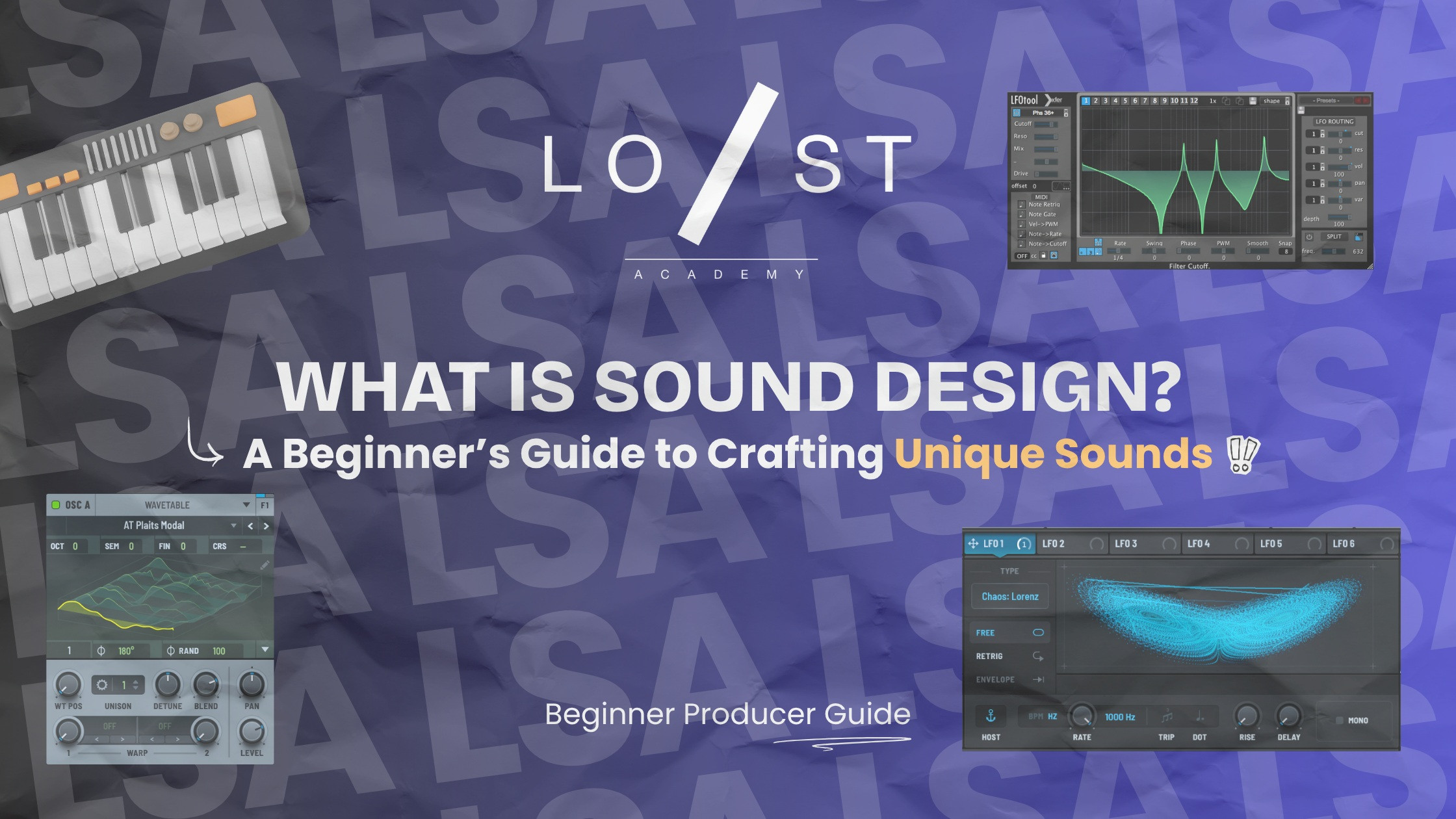
Have you ever listened to a song and wondered how the producer created those rich pads, deep basslines, or futuristic leads that instantly stand out? That’s the magic of sound design. It’s the process of shaping and sculpting sound to match the emotion and identity of your music.
Every memorable record has a sonic signature. The atmosphere in a cinematic score, the punch in an electronic drop, or the airy texture in an ambient track, all of it comes down to the choices a producer makes during sound design. If you’re a beginner in music production, understanding this process can completely transform how you approach your music.
Let’s start with the basics and build from there.
In simple terms, sound design is the process of creating and modifying sounds to achieve a particular feeling, texture, or tone. It’s not just about making new sounds from scratch; it’s also about reimagining existing ones.
Producers often design sounds by:
For example, the soft, evolving pad in a film score or the gritty bassline in a techno track may not exist in any preset. They are often crafted from basic waveforms and carefully shaped through filters, envelopes, and modulation.
Sound design is both technical and creative—it’s where science meets emotion.
Sound design is one of the most powerful ways to define your identity as a music producer.
In short, good sound design doesn’t just make your track sound better—it makes it sound like you.
If you want to understand how sounds are built, there are a few key elements you’ll come across. Think of these as the building blocks of every sound you’ll ever create.
Oscillators generate the raw waveform of a sound. These waveforms—sine, saw, square, and triangle—are the starting point of synthesis.
You can also combine multiple oscillators slightly detuned from each other to create a thicker, more textured sound.
Filters shape the tone of a sound by cutting or emphasizing specific frequencies.
Common filter types include:
As you move the filter cutoff over time, you bring movement and emotion into the sound—a common technique in electronic music.
An envelope determines how your sound behaves over time. It’s controlled by four stages—Attack, Decay, Sustain, and Release (ADSR).
For example, a pluck sound has a fast attack and quick decay, while a pad has a slow attack and long release. Mastering envelopes is key to creating dynamic and expressive sounds.
LFOs are used to create motion. They can modulate almost any parameter—pitch, filter cutoff, volume, or even panning.
This is how you achieve effects like:
Subtle modulation keeps your sounds evolving and prevents them from feeling static.
Effects are where you add character and space. Common choices include:
When used tastefully, effects can turn a simple tone into something cinematic and immersive.
If you’re just starting out, follow this step-by-step workflow:
Start small. A simple bass, pad, or pluck can teach you more about synthesis than endlessly scrolling through presets.
Sound design is the heart of originality in music production. It allows you to move beyond imitation and start developing your own musical voice. The more you experiment and listen critically, the faster you’ll begin to understand what makes sounds connect emotionally.
With time, your productions won’t just sound professional, they’ll sound like you.
At Lost Stories Academy, we teach sound design from the ground up blending synthesis, sampling, and creative production techniques used by professional artists. Our mentors guide you through hands-on sessions so you can craft your own unique sounds and confidently shape your musical identity.
Explore our Music Production Courses today and start building your signature sound.
