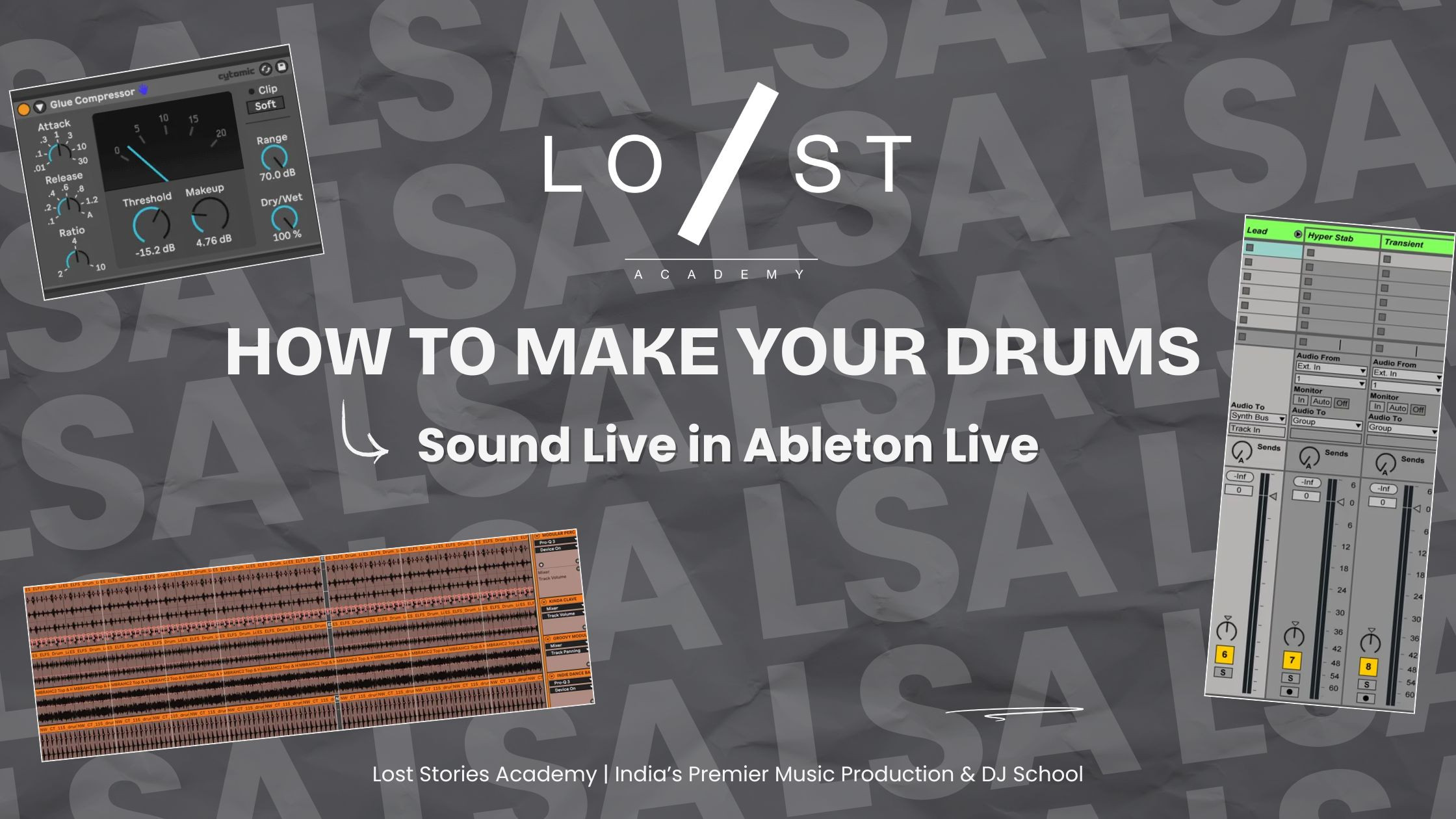
One of the biggest differences between beginner productions and professional mixes is how the drums feel.
Programmed drums often sound too perfect, too stiff, or too clean. Real drums breathe. They move slightly in time, change in velocity, and interact with the room.
The goal is not to fake a live drummer. The goal is to make your drums feel human, dynamic, and present inside the track.
Here’s how to do that inside Ableton Live.
No amount of processing can fix lifeless samples.
Choose drum sounds that already have some character. Look for kicks with subtle saturation, snares with room tone, and hi-hats that are not overly bright or synthetic.
Layering helps too. A dry punchy snare combined with a slightly roomy snare can immediately add depth and realism.
If the source sounds alive, the mix becomes much easier.
Perfect grid timing is one of the fastest ways to make drums sound programmed.
Shift certain hits slightly off the grid. Ghost notes, hi-hats, and percussion benefit the most from this. Even tiny timing variations create groove.
Ableton’s Groove Pool is powerful for this. You can extract groove from live recordings or use built-in swing presets to add subtle timing movement.
The key is subtlety. If the listener notices the timing shift, it is probably too much.
Real drummers never hit every note with the same intensity.
Lower the velocity of ghost notes, slightly vary hi-hats, and add accents on certain kicks or snares. This creates a natural push and pull in the groove.
Velocity variation is one of the simplest ways to turn a robotic pattern into something that feels performed rather than programmed.
Live drums interact with space. Programmed drums often feel like they exist in isolation.
Instead of putting long reverb on individual hits, send drums to a shared room reverb bus. A short room or studio reverb works best.
This makes all drum elements feel like they belong in the same physical environment. It also helps glue the kit together.
Parallel reverb works great here. Blend it quietly until you feel the space rather than clearly hear it.
Live drums have natural dynamics, but they also hit hard.
Parallel compression helps recreate that. Duplicate your drum bus, compress the duplicate aggressively, and blend it back with the original.
This keeps the transient punch while adding body and sustain underneath. It makes drums feel bigger without sounding squashed.
Analog drums naturally pick up harmonics from tape, consoles, and microphones.
Adding gentle saturation to the drum bus can recreate that effect. It thickens transients, adds warmth, and helps drums sit better in the mix.
Even a small amount can make a programmed kit feel more physical and less digital.
Real drummers naturally change intensity throughout a song.
Automate tiny volume changes in different sections. Pull drums back slightly in verses, push them forward in choruses, and add small fills or velocity lifts before transitions.
These small changes create movement and make the performance feel intentional rather than looped.
Shakers, tambourines, and subtle percussion can add realism quickly.
Even low-volume textures help create the sense of a human performance happening in space. They also fill rhythmic gaps that make loops feel repetitive.
Think of these layers as glue rather than spotlight elements.
Making drums sound live is less about tricks and more about thinking like a drummer.
Real drums have variation, space, dynamics, and imperfections. When you introduce those elements intentionally, your programmed drums stop sounding mechanical and start sounding musical.
The goal is not perfection.
The goal is life.
Many of our students work full-time and build their music career step by step. Our courses are structured to support real-life schedules, with practical workflow guidance, personal mentorship, and artist development support.
If you want clarity, direction, accountability, and a supportive music community, we can help you move forward with confidence.
Explore our programs or speak to a mentor.
